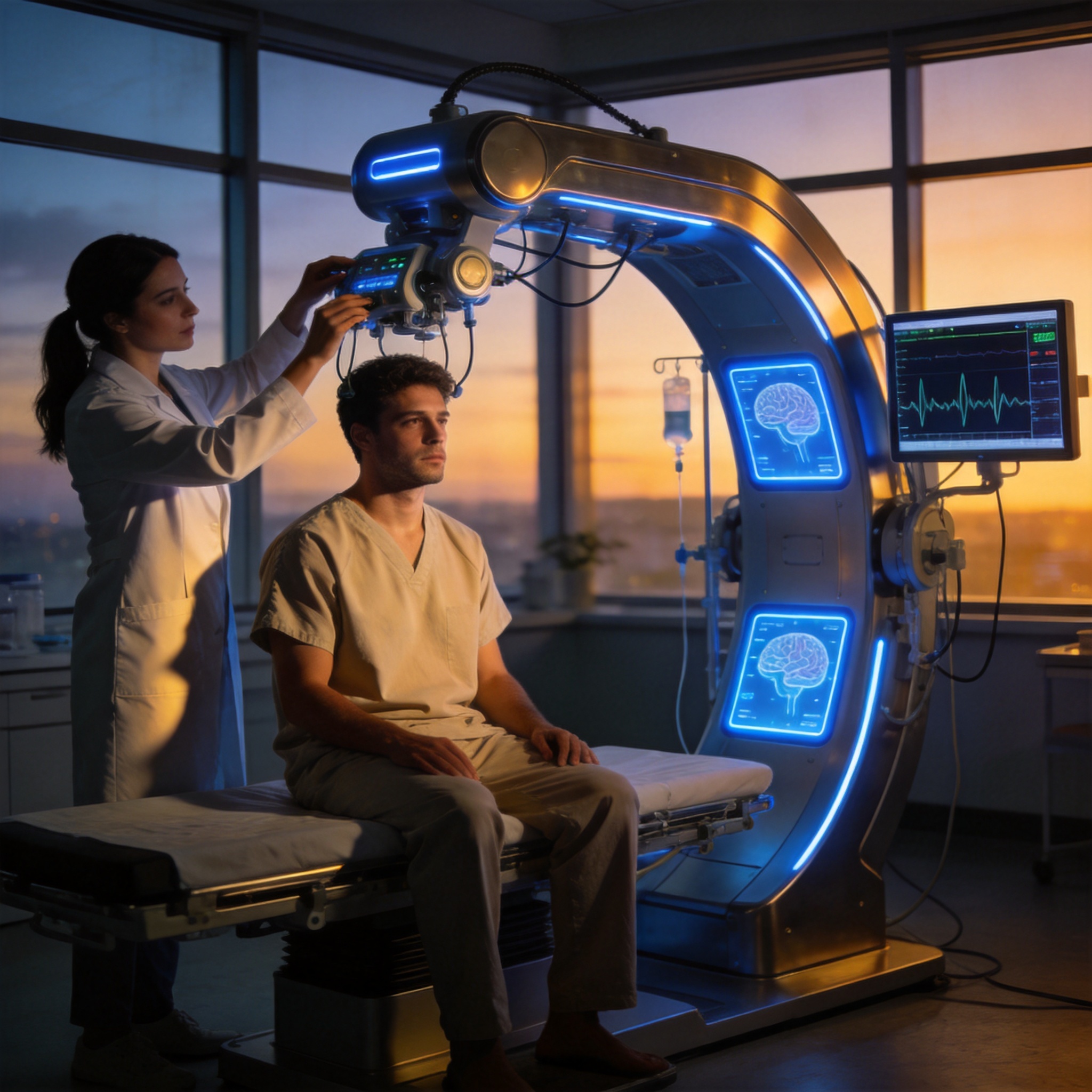
Somewhere in a university hospital, a patient with treatment-resistant depression lies on a gurney, electrodes affixed to her temples, while a machine learning algorithm quietly processes her electronic health records, brain-derived biomarkers, and prior treatment responses to help her psychiatrist determine the precise electrical dose that will coax her brain toward remission. This is not science fiction. It is the emerging frontier where artificial intelligence and one of psychiatry's oldest, most effective — and most misunderstood — interventions are converging. The marriage of algorithms and electrodes is reshaping how clinicians think about severe mental illness, and the implications ripple far beyond the treatment room.
The Enduring Power — and Persistent Stigma — of ECT
Electroconvulsive therapy occupies a peculiar space in modern medicine: it is simultaneously among the most effective treatments in all of psychiatry and one of the most feared by the public. Randomized clinical trials have clearly demonstrated that ECT is highly effective for depression and other severe psychiatric conditions 3. A report from the Consortium for Research in ECT, known as CORE, showed that optimized ECT results in a remission rate of 80 percent or more in severely depressed patients — a figure that dwarfs the response rates of most antidepressant medications 4. The American Psychiatric Association has affirmed that extensive research finds ECT highly effective for the relief of major depression, and clinical evidence indicates that for individuals with uncomplicated, severe depression, the procedure can produce substantial improvement 5.
Yet stigma clings to ECT like a shadow. Decades-old cinematic portrayals — think Jack Nicholson writhing in "One Flew Over the Cuckoo's Nest" — have calcified public perception around images of punishment rather than healing. A 2025 study published in The Guardian examined adverse effects and found that while cognitive side effects, particularly memory disruption, remain a legitimate concern, the overall safety profile of modern ECT is far more favorable than popular culture suggests 30. Contemporary protocols use brief-pulse or ultra-brief-pulse electrical stimulation, general anesthesia, and muscle relaxants, rendering the procedure virtually unrecognizable from its mid-twentieth-century predecessor.
What often gets lost in the stigma debate is the sheer desperation of the patients who need ECT most. These are individuals for whom multiple antidepressants, psychotherapy, and sometimes hospitalization have failed. Research published in Psychiatry Research suggests that ECT use earlier in the course of illness is associated with greater therapeutic response, supporting the case for offering the treatment sooner rather than as a last resort 2. For patients with psychotic depression — a particularly severe subtype involving delusions or hallucinations layered atop profound despair — ECT has demonstrated clinical effectiveness that often surpasses pharmacological approaches 14. The treatment saves lives. The question that artificial intelligence now seeks to answer is whether it can save them more precisely.
""Optimized ECT results in a remission rate of 80 percent or more in severely depressed patients — a figure that dwarfs the response rates of most antidepressant medications.""
Machine Learning Enters the Treatment Room
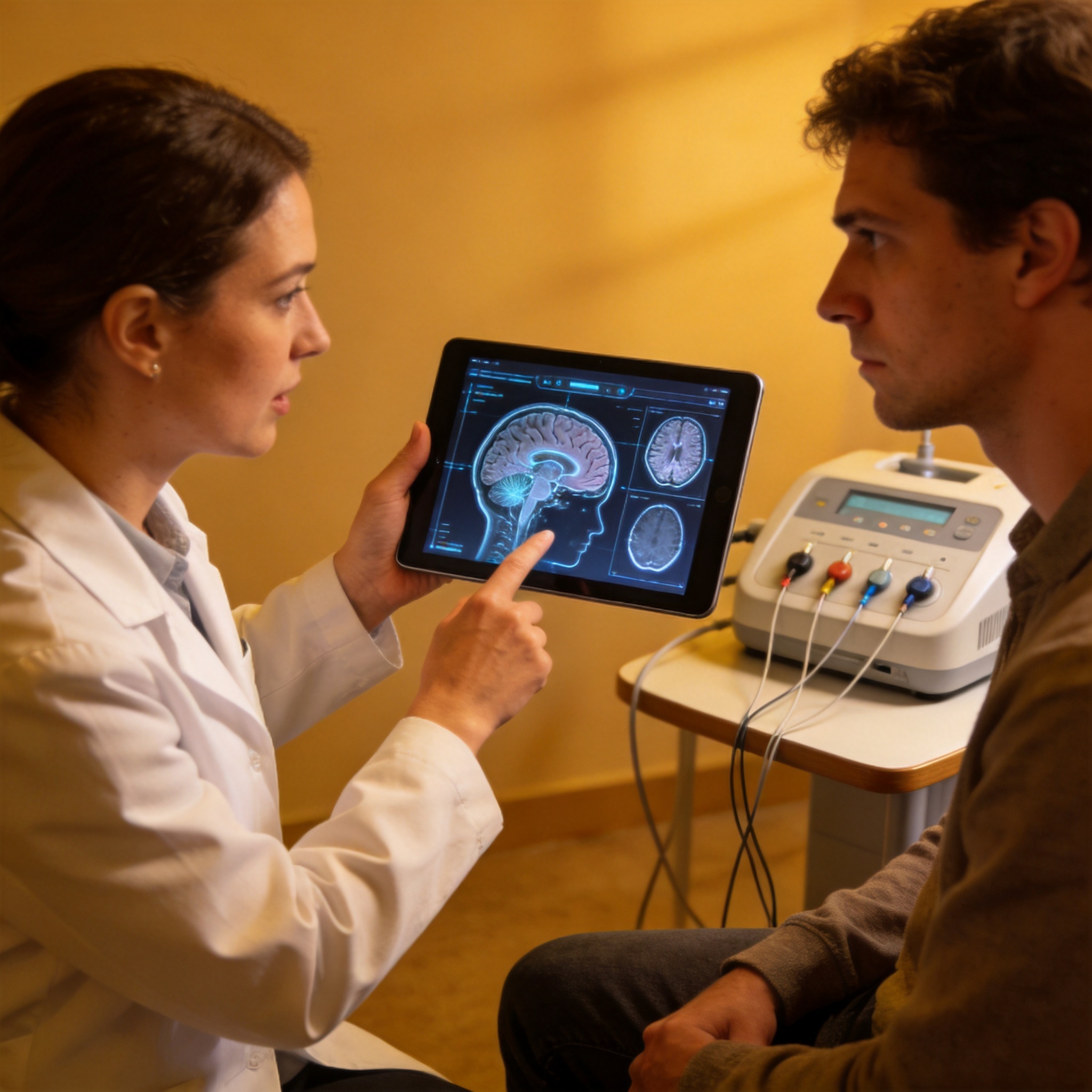
The integration of artificial intelligence into ECT practice is no longer theoretical. Researchers at Aarhus University in Denmark, led by Søren Dinesen Østergaard, have published groundbreaking work on predicting the need for electroconvulsive therapy via machine learning trained on electronic health record data 22. Their models analyze vast datasets — demographic information, diagnostic histories, medication records, hospitalization patterns — to identify which patients are most likely to require and benefit from ECT. The implications are profound: rather than waiting until a patient has cycled through years of failed treatments, clinicians could receive algorithmic guidance pointing toward ECT far earlier in the illness trajectory.
The journal Brain Stimulation has become a key venue for research at this intersection, publishing studies on machine learning applications in electroconvulsive therapy that range from predicting individual seizure quality to forecasting clinical outcomes based on pre-treatment neuroimaging 10. These are not abstract exercises. Every percentage point of improvement in prediction accuracy translates into real patients spared unnecessary suffering, fewer wasted months on ineffective medications, and more targeted deployment of a resource-intensive procedure that requires anesthesia teams, specialized equipment, and multiple treatment sessions.
Meanwhile, the broader AI-in-mental-health ecosystem is expanding at breakneck speed. A 2025 market analysis by Roots Analysis projected that the AI-in-mental-health market would experience significant compound annual growth over the coming decade, driven by advances in natural language processing, computer vision, and predictive analytics 16. The American Psychological Association highlighted personalized mental health care as one of the defining trends shaping the field, noting that AI-driven tools are increasingly capable of tailoring interventions to individual patient profiles 12. Conversational AI platforms have already demonstrated measurable reductions in symptoms of anxiety and depression among users, suggesting that machine intelligence can serve therapeutic functions across the severity spectrum — from mild distress managed through a smartphone app to the profound, life-threatening episodes that warrant ECT 9. The common thread is personalization: the right treatment, for the right patient, at the right time.
""The convergence of artificial intelligence and electroconvulsive therapy represents not a threat to humanistic psychiatry but an amplification of it — empathy sharpened by algorithmic precision.""
Beyond Depression — AI, ECT, and the Psychosis Frontier
Depression may dominate the ECT conversation, but the treatment's role in psychosis — and artificial intelligence's potential to enhance that role — deserves equal attention. Psychotic disorders, including schizophrenia and schizoaffective disorder, represent some of the most disabling conditions in medicine. When antipsychotic medications fail or produce intolerable side effects, ECT offers a viable alternative, particularly for catatonia, treatment-resistant psychosis, and the dangerous overlap of psychotic and mood symptoms. Studies indexed in The Journal of ECT continue to report on these applications, expanding the evidence base with each issue 6.
The Wellcome Trust, one of the world's largest biomedical research charities, has recognized the urgency of this frontier by funding research into generative AI applications for anxiety, depression, and psychosis — a signal that major funders see machine intelligence as integral to the next generation of psychiatric intervention 13. Their investment targets not just chatbot-style tools but deeper computational approaches: algorithms that can parse the linguistic patterns of psychotic speech, detect early warning signs of relapse in electronic health records, and model the neurobiological mechanisms through which treatments like ECT exert their effects.
At Stanford University's interventional psychiatry program, clinicians are already integrating advanced neuromodulation techniques with data-driven decision-making frameworks 15. The vision is a clinical workflow in which AI does not replace the psychiatrist but augments her judgment — flagging patients who are deteriorating before a crisis occurs, recommending stimulation parameters based on individual brain anatomy, and tracking treatment response with a granularity that human observation alone cannot achieve. Research from Frontiers in Psychiatry has explored how machine learning models can synthesize multimodal data — clinical scales, EEG recordings, neuroimaging, genetic markers — into unified predictions of ECT outcome 21. The complexity of psychosis, with its heterogeneous presentation and unpredictable course, makes it an ideal candidate for the pattern-recognition strengths of artificial intelligence.
Emerging alternatives like magnetic seizure therapy are also entering the conversation, offering convulsive treatment with potentially fewer cognitive side effects, and AI stands ready to optimize these newer modalities as well 3.

""Every percentage point of improvement in prediction accuracy translates into real patients spared unnecessary suffering and fewer wasted months on ineffective medications.""
Ethical Currents and the Road Ahead
No discussion of AI in psychiatric treatment is complete without confronting the ethical undertow. Electroconvulsive therapy already raises questions of informed consent — patients in the grip of severe psychosis or suicidal depression may have compromised decision-making capacity. Layering algorithmic recommendations onto that dynamic introduces new complexities. If a machine learning model recommends ECT and the patient suffers adverse cognitive effects, who bears responsibility? The algorithm's developers? The clinician who followed its guidance? The institution that deployed it?
The Royal Australian and New Zealand College of Psychiatrists has convened discussions on artificial intelligence in psychiatry, emphasizing the need to balance innovation with ethics and clinical impact 24. Transparency is paramount: clinicians must understand how an algorithm reaches its recommendations, and patients deserve to know when AI is influencing their treatment plan. The "black box" problem — the opacity of many deep learning models — is not merely a technical inconvenience in this context. It is a moral hazard. A systematic review published in Acta Neuropsychiatrica underscored the importance of interpretable models, arguing that clinical adoption of machine learning in ECT hinges on the ability of psychiatrists to interrogate and trust algorithmic outputs 22.
Data privacy presents another fault line. The electronic health records that fuel these predictive models contain some of the most sensitive information imaginable — psychiatric diagnoses, substance use histories, suicidal ideation, involuntary commitment records. Robust de-identification protocols and strict governance frameworks are non-negotiable prerequisites for responsible deployment. Delve Insight's analysis of AI in mental health diagnosis and treatment noted that regulatory uncertainty remains one of the sector's most significant headwinds, with frameworks struggling to keep pace with the technology's rapid evolution 20.
Yet for all these cautions, the trajectory is unmistakable. The convergence of artificial intelligence and electroconvulsive therapy represents not a threat to humanistic psychiatry but an amplification of it — a future in which the clinician's empathy is sharpened by the algorithm's precision. The patients who stand to benefit most are those who have suffered longest and responded least: the treatment-resistant, the chronically psychotic, the suicidal. They deserve every tool that science can offer. And increasingly, that toolkit includes machines that learn.