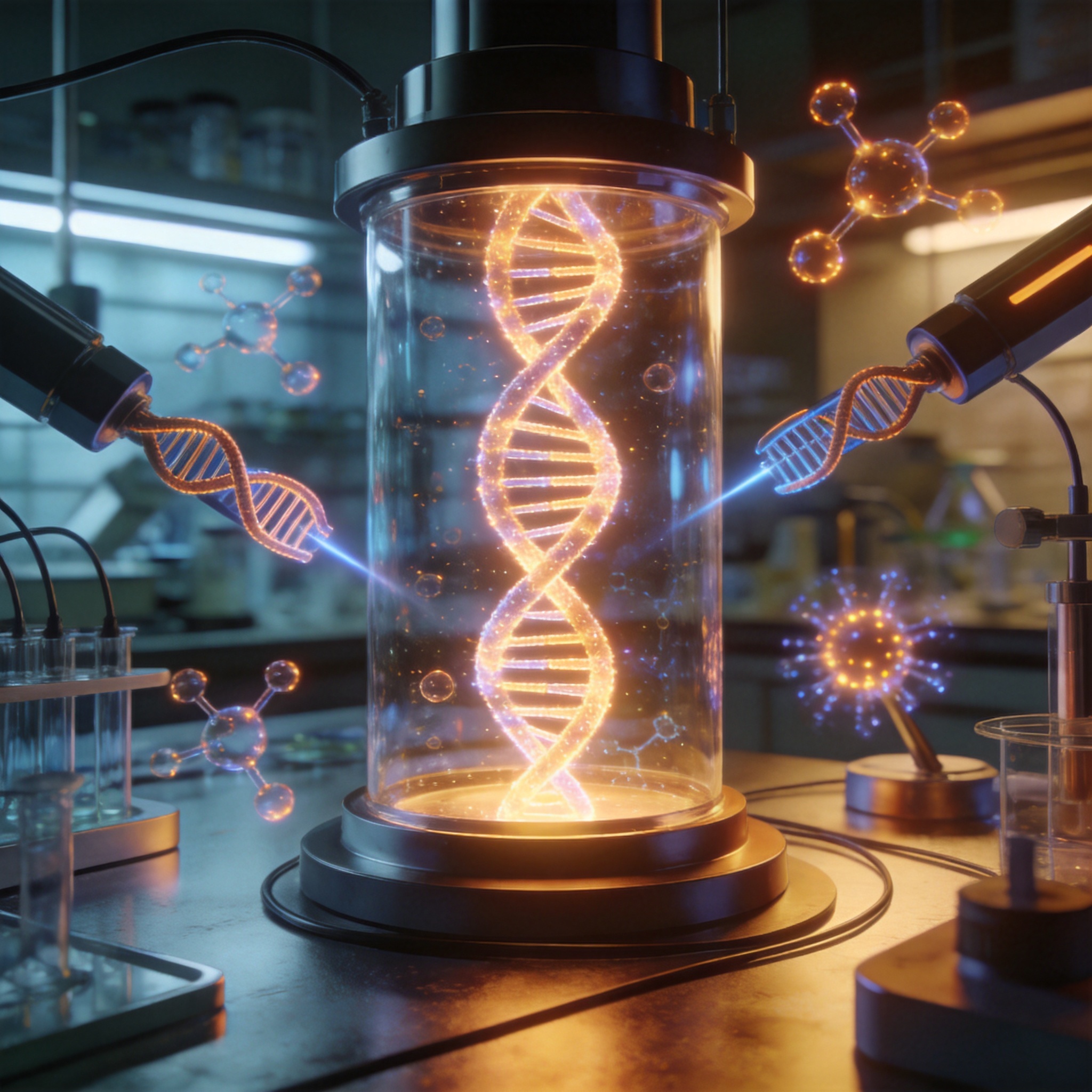
Somewhere in a climate-controlled laboratory, a cell divides. It metabolizes sugar, produces protein, and responds to light — all the hallmarks of life. But this cell was not born. It was built. Its genome, stitched together nucleotide by nucleotide, was drafted on a computer screen before it ever existed in the physical world. Welcome to the era of synthetic biology, where the boundary between the living and the engineered has dissolved into something thrilling, unsettling, and profoundly consequential. The question is no longer whether we can redesign life from scratch. It is what we choose to do with that power.
From Reading the Code to Writing It
For most of its history, biology was a discipline of observation. Scientists cataloged species, dissected organisms, and decoded genomes — always reading nature's instructions, never authoring their own. Synthetic biology has shattered that paradigm. By combining the principles of engineering with molecular biology, the field seeks to design and build entirely new biological systems — or radically redesign existing ones — for useful purposes 2. Cells are no longer seen merely as things to study. In 2026, they are increasingly treated as systems that can be programmed to sense, produce, repair, and react in designed ways 3.
The intellectual roots stretch back decades, but the modern era arguably ignited in 2010 when J. Craig Venter's team created the first synthetic cell, an organism driven by a genome assembled entirely from chemical components. Venter, who passed away recently, transformed our understanding of life itself and left behind a legacy that continues to accelerate 2. His work demonstrated something that had once been purely theoretical: that life could be booted up from a digital blueprint.
Today the toolkit has expanded enormously. CRISPR gene-editing, DNA synthesis platforms, and computational modeling allow researchers to write genetic code with a precision that would have seemed fantastical a generation ago. SynBio involves editing and redesigning the biological components, systems, and interactions that make up life at every scale — from individual genes to entire organisms 1. Stanford's 2026 report on emerging technologies noted that AI-driven protein design platforms like Chai-2 achieved a sixteen percent success rate in designing functional antibodies entirely from scratch by mid-2025, a benchmark that stunned the structural biology community 4. What once required years of laboratory evolution can now be prototyped in weeks. The reading phase of biology is over. The writing phase has begun — and the authors are getting faster by the month.
""The reading phase of biology is over. The writing phase has begun — and the authors are getting faster by the month.""
Programming Cells Like Silicon

If the first revolution was learning to edit DNA, the second is learning to think of cells as programmable hardware. Researchers at the University of North Carolina recently created artificial cells that behave like living ones — sensing their environment, communicating with neighbors, and carrying out complex biochemical tasks — despite being assembled entirely from non-living components 3. The breakthrough underscores a conceptual shift that has swept through the field: biology is becoming an engineering discipline, complete with standardized parts, modular designs, and iterative prototyping.
This engineering mindset has given rise to what practitioners call genetic circuits — sequences of DNA that function like logic gates in a computer chip. A cell can be programmed to detect a toxin in a water supply and respond by producing a fluorescent signal. Another can be instructed to manufacture a cancer drug only when it encounters a tumor's molecular signature. Synthetic biology uses engineering-based modeling methods to modify the structures of existing organisms or to develop entirely new ones from scratch 9. The analogy to software is imperfect — biology is messier, noisier, and far less predictable than silicon — but it is no longer merely a metaphor.
The commercial implications are staggering. According to Coherent Market Insights, the global synthetic biology market is on a steep growth trajectory, driven by applications in pharmaceuticals, agriculture, industrial chemicals, and biofuels 11. Meanwhile, a 2024 report by Arthur D. Little identified cell-free systems and AI-augmented design as two of the most disruptive near-term trends, enabling researchers to build biological functions outside living cells entirely 12. The iGEM competition, the field's premier student showcase, featured projects in 2025 that ranged from engineered bacteria that degrade microplastics to yeast strains designed to produce high-value fragrances 25. What unites these efforts is a shared conviction: that life's machinery can be repurposed, optimized, and even invented from whole cloth.
""When we can write a human genome from raw chemicals, what does it mean to be natural?""
The Promise — and the Peril
The potential applications read like a catalog of humanity's most urgent needs. Synthetic biology has already delivered semi-synthetic artemisinin, the frontline anti-malaria drug, through engineered yeast — a feat that stabilized global supply chains and saved countless lives 6. Researchers are now pursuing synthetic organisms that can capture atmospheric carbon dioxide more efficiently than any tree, produce sustainable aviation fuel from agricultural waste, and manufacture transplant-ready human tissues in bioreactors. A roadmap published in a leading journal outlined the path toward synthesizing minimal cells that could reveal the fundamental principles of life itself, potentially unlocking mechanisms that operated at life's very origin 5.
Yet the power to redesign life raises questions that no laboratory protocol can answer. The Convention on Biological Diversity's 2026 open-ended forum highlighted growing concerns about the use of Digital Sequence Information — genetic data stored in online databases — to design organisms remotely, without physical access to biological samples 8. If a pathogen's genome can be downloaded and reconstructed, what guardrails prevent misuse? The OECD's 2025 report on synthetic biology called for strengthened international governance frameworks, warning that the field's democratization — cheaper tools, open-source databases, community bio-labs — simultaneously broadens opportunity and risk 20.
Biosecurity experts worry about dual-use research: the same techniques that engineer a beneficial microbe could, in theory, engineer a harmful one. And ecological questions loom large. Releasing synthetic organisms into the environment introduces variables that no model can fully predict. What happens when an engineered microbe encounters wild ecosystems? Does it compete, cooperate, or collapse? These are not hypothetical dilemmas. They are active policy debates unfolding at the United Nations, in national legislatures, and within the scientific community itself. The technology is moving faster than the governance structures designed to contain it — a familiar story in the history of science, but one with uniquely high stakes when the subject is life itself.

""Life, it turns out, was always a technology. We are only now learning to use it.""
The Next Chapter of Life's Story
The trajectory of synthetic biology points toward a future that previous generations would have classified as science fiction. Work has already begun on the Synthetic Human Genome Project, a controversial initiative to create the building blocks of human life from scratch, in what is believed to be a world first 7. The project does not aim to create synthetic humans — its stated goals involve advancing organ transplantation, vaccine development, and our understanding of genomic disease — but its very existence forces a reckoning with questions that once belonged exclusively to philosophy and theology. When we can write a human genome from raw chemicals, what does it mean to be natural?
Artificial intelligence is accelerating the field at a pace that even its practitioners find dizzying. Machine-learning models now predict protein structures, optimize metabolic pathways, and generate novel genetic sequences that no evolutionary process has ever produced 10. The convergence of AI and synthetic biology has created a feedback loop: AI designs biological experiments, biological data trains better AI, and the cycle compresses timelines that once stretched across doctoral dissertations into sprints measured in months. Emerging trends for 2026 include AI-integrated biodesign platforms, cell-free manufacturing systems, and living therapeutics — engineered microbes delivered directly to patients to treat diseases from inflammatory bowel syndrome to certain cancers 14.
Perhaps the most profound shift is philosophical. Synthetic biology compels us to abandon the comfortable notion that life is something we merely inherit. It is becoming something we author. The researchers building artificial cells, the policymakers drafting biosafety regulations, the entrepreneurs launching synbio startups — all are participants in an experiment with no predetermined outcome. The tools are sharper than ever. The canvas is the living world. And the only certainty is that the organisms emerging from these labs will challenge every assumption we hold about the boundary between the made and the born. Life, it turns out, was always a technology. We are only now learning to use it.