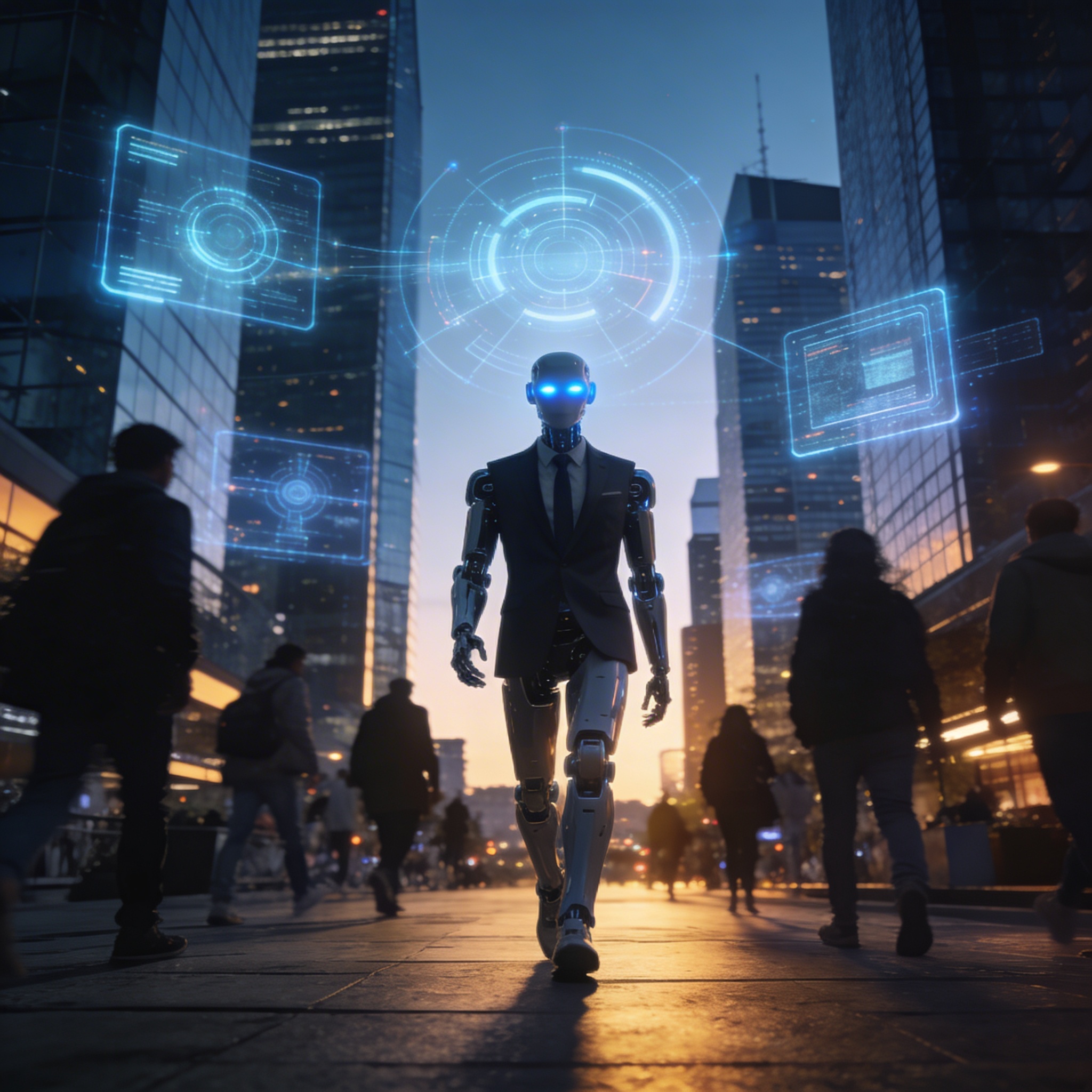
The Machine Awakens: AI's Bold New World
From boardrooms to operating rooms, artificial intelligence is rewriting the rules of human civilization — and the transformation is just beginning.

Somewhere right now, an AI agent is closing a sales deal, diagnosing a tumor, writing production-grade code, and composing a symphony — simultaneously, and without taking a coffee break. We are living through the most consequential technological inflection point in human history, a moment so vast in its implications that even the experts who built these systems struggle to fully articulate where it all leads. The AI market hit $757 billion in 2025. By 2030, projections suggest it will eclipse $3.6 trillion. The machine has not just awakened. It has stood up, stretched its arms, and started rearranging the furniture.
Somewhere right now, an AI agent is closing a sales deal, diagnosing a tumor, writing production-grade code, and composing a symphony — simultaneously, and without taking a coffee break. We are living through the most consequential technological inflection point in human history, a moment so vast in its implications that even the experts who built these systems struggle to fully articulate where it all leads. The AI market hit $757 billion in 2025. By 2030, projections suggest it will eclipse $3.6 trillion. The machine has not just awakened. It has stood up, stretched its arms, and started rearranging the furniture.
From Experiment to Engine: AI Moves Into the Mainstream
For years, artificial intelligence lived in the realm of research labs, TED Talks, and breathless Silicon Valley pitch decks. That era is definitively over. According to McKinsey's 2025 Global Survey on AI, organizations reporting measurable value from AI deployments have doubled in just two years. More than half of business leaders — 50 to 52 percent, according to data compiled by Jalasoft — now actively support AI integration across their operations. This is not a fringe enthusiasm. This is a structural shift in how the global economy functions.
The numbers tell a compelling story, but the real drama is in the details. Companies like Microsoft, IBM, and Google are no longer simply building AI tools — they are weaving AI into the connective tissue of enterprise workflows. Microsoft's 2026 trend report highlights AI as a "true partner" in teamwork, security, and research acceleration. IBM's technology forecasters describe an era in which AI stops being a feature and becomes the operating system of business itself.
What changed? Scale, mostly. The models got bigger, faster, and cheaper to deploy. Cloud infrastructure matured. And crucially, the use cases became undeniable. A mid-sized logistics company in Atlanta reduced route planning time by 70 percent using an AI optimization layer. A regional hospital network in the Netherlands cut diagnostic backlogs by deploying AI-assisted radiology screening. These are not hypotheticals lifted from a white paper. They are the quiet, unglamorous revolutions happening in ordinary organizations around the world, every single day.
The adoption tipping point, as analysts at National University describe it, arrived faster than almost anyone predicted. And now that the gates are open, there is no credible scenario in which they close again.
---

""The AI market hit $757 billion in 2025 — and the machine has not just awakened. It has stood up, stretched its arms, and started rearranging the furniture.""
The Rise of Agentic AI: When Machines Start Making Decisions

If the last decade of AI was about machines that could answer questions, the next decade belongs to machines that can take action. Welcome to the age of agentic AI — autonomous systems capable of planning, executing, and iterating on complex multi-step tasks with minimal human supervision. Progress Software calls agentic AI orchestration the single most important trend of 2026, and the evidence is difficult to argue with.
Think of an AI agent not as a chatbot but as a tireless digital employee. It can browse the web, write and run code, send emails, manage calendars, negotiate with APIs, and loop back to refine its own outputs — all in pursuit of a goal a human set once and then walked away from. OpenAI's operator-class models, Google's DeepMind agents, and a sprawling ecosystem of startups are racing to define what this new category of tool can do.
The implications for the workforce are profound and, depending on your vantage point, either thrilling or terrifying. Forbes contributor Charles Towers-Clark, writing in December 2025, outlined ten predictions for AI in 2026, several of which center on agentic systems replacing not just repetitive tasks but entire job functions — including roles in customer service, paralegal research, financial analysis, and software testing. MIT Sloan Management Review echoes this, noting that generative AI is rapidly evolving from a productivity enhancer into a genuine organizational decision-maker.
But the most sophisticated analysts resist the simple narrative of replacement. What agentic AI more accurately produces is role transformation. The paralegal does not disappear — she becomes a supervisor of AI agents, reviewing outputs, catching errors, and applying the human judgment that no model has yet convincingly replicated. The developer does not vanish — he shifts from writing boilerplate code to architecting systems and evaluating AI-generated solutions. The job changes. The human remains. For now.
---
""The governance gap is not a reason to stop. It is a reason to build smarter, with intention and accountability baked into the architecture from the start.""
The Governance Gap: Racing Ahead Without a Roadmap
Speed is intoxicating. It is also dangerous. As AI capabilities accelerate at a pace that regularly embarrasses even the most optimistic forecasts, the world's regulatory and ethical frameworks are struggling to keep up — and the gap between technological possibility and institutional readiness has never been wider or more consequential.
The European Union's AI Act, which came into force in 2024 and entered full enforcement in 2025, represents the most comprehensive attempt yet to impose structured governance on AI development. It categorizes AI systems by risk level, mandates transparency requirements, and bans certain applications outright — including real-time biometric surveillance in public spaces. It is, by any measure, a serious piece of legislation. It is also, critics argue, already partially obsolete, written for a technological landscape that the models themselves have since outgrown.
In the United States, the regulatory picture remains fragmented. Executive orders have come and gone. Congressional hearings have produced memorable soundbites and little binding law. The result is a patchwork environment in which American AI companies operate with extraordinary latitude — a competitive advantage in the short term, and a potential liability in the long term, as questions of accountability, bias, and misuse grow louder and more urgent.
IBM's 2026 trend analysis places security, governance, and controls among the defining challenges of the coming year. Progress Software's analysts agree, warning that organizations deploying AI without robust oversight frameworks are accumulating invisible risk. Data privacy violations, algorithmic discrimination, and AI-generated misinformation are not theoretical harms. They are documented, recurring, and scaling alongside the technology itself.
The governance gap is not a reason to stop. It is a reason to build smarter, with intention and accountability baked into the architecture from the start — not bolted on as an afterthought when something goes catastrophically wrong.
---

""The future of AI will be written not by the models themselves, but by the choices humans make about how to deploy, constrain, and share the extraordinary power those models represent.""
The Human Equation: What We Gain, What We Risk, and What We Choose
Strip away the market projections and the technical jargon, and the future of AI is ultimately a story about human beings — what we value, what we fear, and what kind of world we are willing to build. The Cengage Group's 2025 analysis of AI's future impacts makes a point that deserves to be shouted from every conference stage: AI has moved from promise to practice, and the people most affected by that shift are not always the ones with the most power to shape it.
Education is one of the most striking battlegrounds. AI tutoring systems are now capable of personalizing learning pathways in real time, adapting to a student's pace, identifying gaps in understanding, and delivering targeted interventions that a single classroom teacher with thirty students simply cannot replicate. Early pilots in school districts from Los Angeles to Lagos show measurable improvements in learning outcomes. The promise is genuine. But so is the risk that these tools deepen existing inequalities if access remains unevenly distributed.
Healthcare tells a similarly double-edged story. AI diagnostic tools are detecting cancers earlier, predicting sepsis before symptoms appear, and accelerating drug discovery at a scale that would have seemed like science fiction a decade ago. National University's AI statistics report notes that AI in healthcare could contribute to saving up to 400,000 lives annually in the United States alone by improving diagnostic accuracy. That is not a statistic to gloss over. That is a revolution in human welfare.
And yet. The workers displaced by automation are real people with real mortgages. The communities built around industries that AI is quietly dismantling deserve more than a pivot-to-tech platitude. The mental health implications of living in an economy where human skill feels perpetually under threat are only beginning to be studied and understood.
The future of AI will be written not by the models themselves, but by the choices humans make about how to deploy, constrain, and share the extraordinary power those models represent. We are not passengers on this train. We are, still, the engineers — and the track ahead branches in more directions than we have yet been willing to honestly map.
---