
Not long ago, the most ambitious thing an AI could do was answer a customer's question about store hours. Today, that same category of software is booking flights, writing and executing code, managing supply chains, and autonomously resolving disputes — without a single human keystroke in between. The shift from conversational chatbot to fully autonomous agent is not a distant forecast. It is happening now, accelerating with startling speed, and forcing every industry to reckon with a profound question: what exactly is left for humans to do?
The Architecture of Autonomy — How AI Agents Actually Work
To understand why AI agents represent such a dramatic leap forward, it helps to understand what separates them from the chatbots that came before. Traditional chatbots were, at their core, sophisticated lookup tables — pattern-matching engines that retrieved pre-written responses based on keywords. They were reactive, narrow, and brittle. Ask one a question slightly outside its training, and it collapsed into confusion. AI agents are something fundamentally different.
An AI agent is an autonomous entity designed to achieve a goal 6. It doesn't simply respond — it plans, executes, monitors its own progress, and corrects course when things go wrong 1. The architecture typically involves four core capabilities: perception (gathering information from its environment), reasoning (deciding what to do with that information), action (using tools, APIs, or software to execute decisions), and memory (retaining context across steps to maintain coherence) 2. This loop — observe, think, act, reflect — is what makes agents genuinely powerful.
Kanerika, a technology research firm, traces this evolution across six distinct architectural stages, from rule-based chatbots all the way through to fully autonomous systems capable of multi-step reasoning and self-correction 9. Each stage represents not just a technical upgrade but a philosophical shift in how we conceive of machine intelligence. Earlier systems were designed to answer. Modern agents are designed to accomplish.
The practical implications of this shift are enormous. Where a chatbot might tell a customer their package is delayed, an agent can identify the delay, contact the supplier, reroute the shipment, notify the customer, update the internal logistics dashboard, and log the incident for future process improvement — all within seconds, all without supervision. This is not hypothetical. Companies are deploying exactly these kinds of systems today, across industries from financial services to healthcare to retail 4.
What makes this moment particularly significant is the convergence of large language models with tool-use capabilities and persistent memory. Earlier AI systems had intelligence but no agency. Modern agents have both — and that combination is what makes the current era feel genuinely unprecedented 5.

"The chatbot era taught us that AI could talk. The agent era is teaching us something far more consequential: that AI can act."
The Numbers Don't Lie — A Market Exploding in Real Time
The data surrounding AI agents is staggering, and it is moving fast. According to MarketsandMarkets, the global AI agents market is on a trajectory that analysts describe as one of the fastest expansions in enterprise software history 24. Gartner, one of the world's most respected technology research firms, has predicted that agentic AI will autonomously resolve 80 percent of common customer service issues without human intervention by 2029 22. That is not a marginal improvement — it is a structural transformation of an entire industry vertical.
The business appetite for this technology is equally striking. A 2025 report from Capgemini found that enterprise interest in AI agents has surged dramatically, with organizations across sectors accelerating pilot programs and full deployments alike 17. Meanwhile, statistics compiled by MasterofCode indicate that AI agent adoption is outpacing even the early growth curves of cloud computing and mobile enterprise software 12.
The workforce implications are already being felt. A January 2026 poll by Mercer found that 40 percent of employees are now concerned about job loss due to AI, up sharply from 28 percent in 2024 [from recent news]. That anxiety is understandable. But the picture is more nuanced than a simple displacement narrative. Research compiled by Go-Globe suggests that AI agents are not replacing humans so much as redistributing human effort — handling repetitive, time-consuming tasks so that workers can focus on judgment-intensive work 8. According to Slack's internal research cited in the same analysis, employees who work alongside AI agents report meaningful improvements in productivity and job satisfaction 8.
The industries leading adoption tell their own story. Financial services firms are deploying agents for real-time fraud detection, portfolio analysis, and regulatory compliance monitoring 4. Healthcare organizations are using them to manage patient intake, process insurance claims, and flag anomalies in diagnostic data. In IT service management, the shift from reactive chatbots to proactive autonomous agents is being described as the most significant operational change since the introduction of cloud infrastructure [from rezolve.ai research].
Exploding Topics, which tracks search and interest trends across technology sectors, confirms that "AI agents" as a search category has seen exponential growth over the past eighteen months 27. This is not hype chasing hype. The underlying deployments are real, measurable, and growing.
"The most valuable human skills in the next five years will be those that complement rather than compete with agent capabilities — creativity, ethical reasoning, and the wisdom to ask the right questions."
The Hard Problems — Trust, Safety, and the Limits of Autonomy
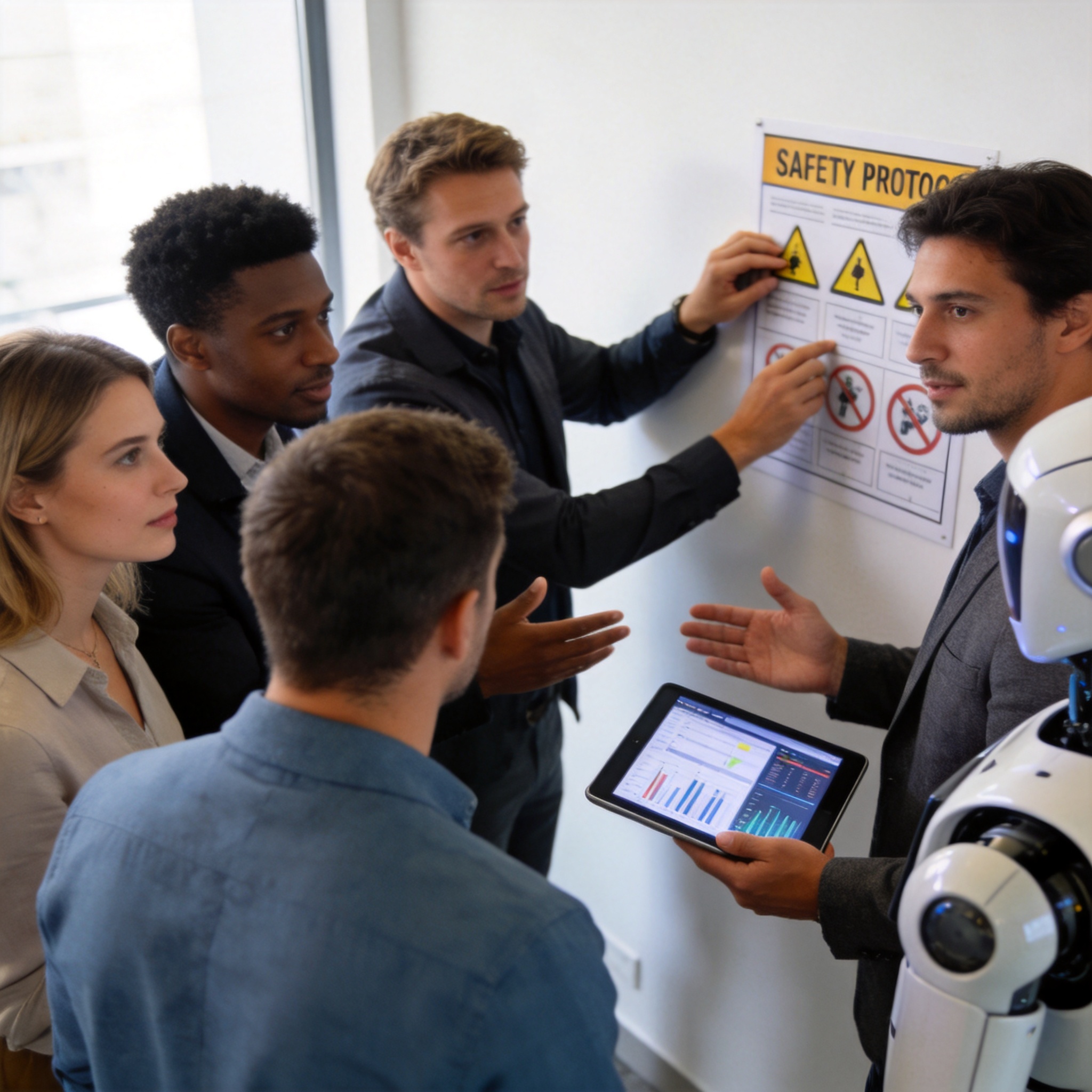
For all the excitement, the rise of AI agents carries real and serious risks that the industry is only beginning to grapple with. The more autonomy you grant a system, the more consequential its mistakes become. An agent that can execute transactions, send emails on behalf of executives, and modify databases is also an agent that can execute the wrong transaction, send a damaging email, and corrupt critical data — potentially before any human notices.
CIO Magazine has argued forcefully that the industry's obsession with building "super agents" — all-powerful autonomous systems capable of handling everything — is precisely the wrong instinct 7. The more disciplined and commercially successful approach, the publication contends, involves designing agents with clearly defined scopes, robust human-in-the-loop checkpoints, and hard limits on what they can do without explicit authorization 7. In other words: keep them in their lanes.
MIT Sloan Management Review frames the challenge in terms of trust calibration 13. Organizations need to develop frameworks for deciding not just what agents can do, but under what conditions they should be permitted to act without oversight. That requires new governance structures, new audit trails, and new categories of accountability that most enterprises are not yet equipped to provide.
Security is another acute concern. As AI agents gain access to more systems and data, they become high-value targets for adversarial manipulation. Researchers have demonstrated techniques — known as prompt injection attacks — in which malicious instructions embedded in external data can hijack an agent's behavior, causing it to act against its operator's intentions 5. Infor's technical analysis of agent architecture highlights that robust safeguards, including input validation, permission scoping, and behavioral monitoring, are essential prerequisites for any serious enterprise deployment 2.
There is also the subtler problem of accountability. When an autonomous agent makes a decision that causes harm — financial, reputational, or otherwise — who is responsible? The developer? The deploying organization? The individual who configured the agent? These questions do not yet have clear legal or ethical answers, and the gap between technological capability and governance maturity is widening with every passing quarter 26.

"The real debate about AI agents is not about direction — it is about shape. Every organization must decide not what to automate, but what humans should own."
The Road Ahead — Designing the Autonomous Workforce of Tomorrow
Despite the genuine risks, the trajectory of AI agents is not in question. The real debate is about shape, not direction. What does a thoughtfully designed autonomous workforce actually look like? And how do organizations build toward it without sacrificing the human judgment that remains irreplaceable?
The most forward-thinking enterprises are approaching this not as a technology deployment but as an organizational redesign. Rather than asking "what can we automate?" they are asking "what should humans own?" — and building agent architectures around that distinction. This framing treats AI agents as colleagues with defined roles and boundaries, not as universal problem-solvers 3. It is a subtle but important difference, and companies that grasp it early are gaining measurable competitive advantages.
The no-code movement is accelerating this democratization. Platforms that allow non-technical employees to configure and deploy their own agents — without writing a single line of code — are making agentic AI accessible far beyond the engineering department 6. This is expanding the surface area of adoption dramatically, pushing agents into marketing, legal, HR, and operations functions that would have seemed implausible targets just two years ago.
Looking further ahead, the concept of multi-agent systems — networks of specialized agents that collaborate, delegate, and check each other's work — is emerging as the dominant architectural paradigm for complex enterprise tasks 1. Rather than one powerful agent doing everything, organizations are building ecosystems of focused agents, each expert in a narrow domain, coordinating toward shared goals. This mirrors, in interesting ways, how effective human teams are structured.
Prompt Engineering Institute describes the next five years as a period of profound labor market recalibration, in which the most valuable human skills will be those that complement rather than compete with agent capabilities — creativity, ethical reasoning, relational intelligence, and the ability to ask the right questions 26. The workers who thrive will not be those who outrun automation, but those who learn to direct it with wisdom and intention.
The chatbot era taught us that AI could talk. The agent era is teaching us something far more consequential: that AI can act. And in a world where action is power, that changes everything.
---