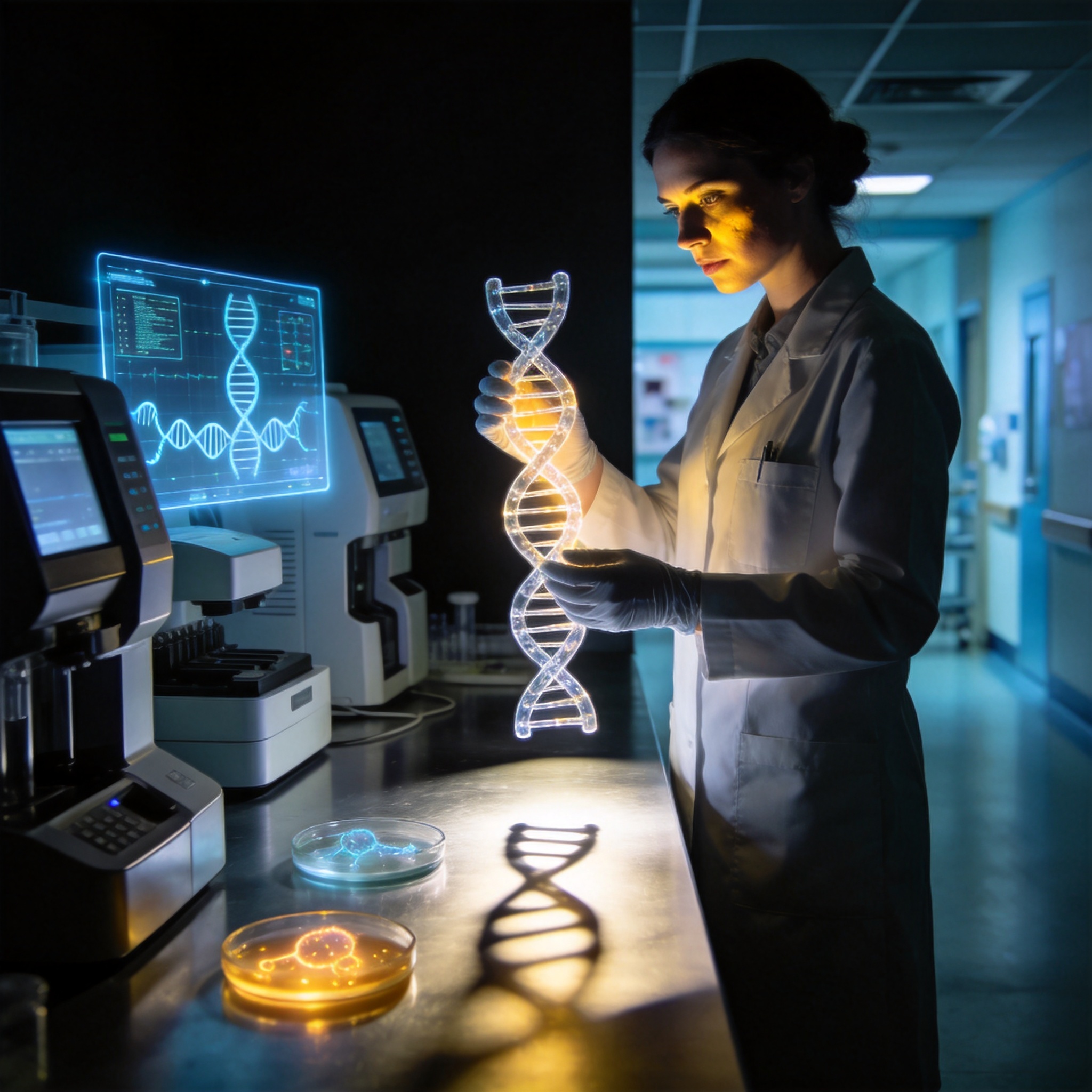
Imagine sitting in your doctor's office and receiving a treatment plan written not by guesswork, not by population-wide statistics, but by the precise molecular blueprint you were born with. That moment — once the stuff of science fiction — is rapidly becoming standard practice. Across hospitals, research labs, and clinics worldwide, physicians are wielding your DNA like never before: as a diagnostic lens, a predictive map, and a therapeutic target. The age of one-size-fits-all medicine is ending. The age of your genome is here.
The Blueprint Revolution — Reading the Code That Makes You, You
For most of modern medical history, doctors treated patients as members of categories — diabetics, cancer patients, hypertensives — rather than as individuals. A drug that worked for 60 percent of a population was considered a success, even as the remaining 40 percent quietly suffered side effects or saw no benefit at all. That calculus is changing, and it is changing fast.
Genomic testing — the analysis of a person's DNA to identify variants that influence health, disease risk, and drug response — has moved from the research laboratory into mainstream clinical practice with remarkable speed 26. The Mayo Clinic describes genomic testing as a tool that can identify changes in chromosomes, genes, or proteins that may signal increased risk for certain conditions, guide treatment decisions, or inform family members of inherited risks 26. What was once a months-long, million-dollar process has been compressed into days and hundreds of dollars, making it increasingly accessible to everyday patients 7.
The implications are staggering. Researchers at the National Council on Aging note that genomic testing now encompasses a broad spectrum of applications — from detecting single-gene disorders to profiling complex, multi-gene conditions like heart disease and cancer 17. Physicians are no longer waiting for symptoms to appear before acting. Instead, they are scanning the genome proactively, looking for inherited mutations, pharmacogenomic markers that predict drug sensitivity, and epigenetic signatures that reveal how fast a patient's body is biologically aging 9.
Personalized medicine, once an aspirational phrase in academic journals, has become a practical framework for leading clinicians. According to reporting from Top Doctor Magazine, physicians in 2026 are building precision treatment plans that begin with a comprehensive genomic workup — sequencing a patient's tumor, blood, or tissue to identify the specific molecular drivers of their condition before a single prescription is written 6. The result is a medical encounter that is, for the first time in history, truly personal. Your DNA is no longer just a curiosity. It is a clinical instrument.
---
""The physician of 2026 is not replacing their judgment with a machine — they are amplifying it with one.""
AI Meets the Genome — When Algorithms Become Co-Physicians
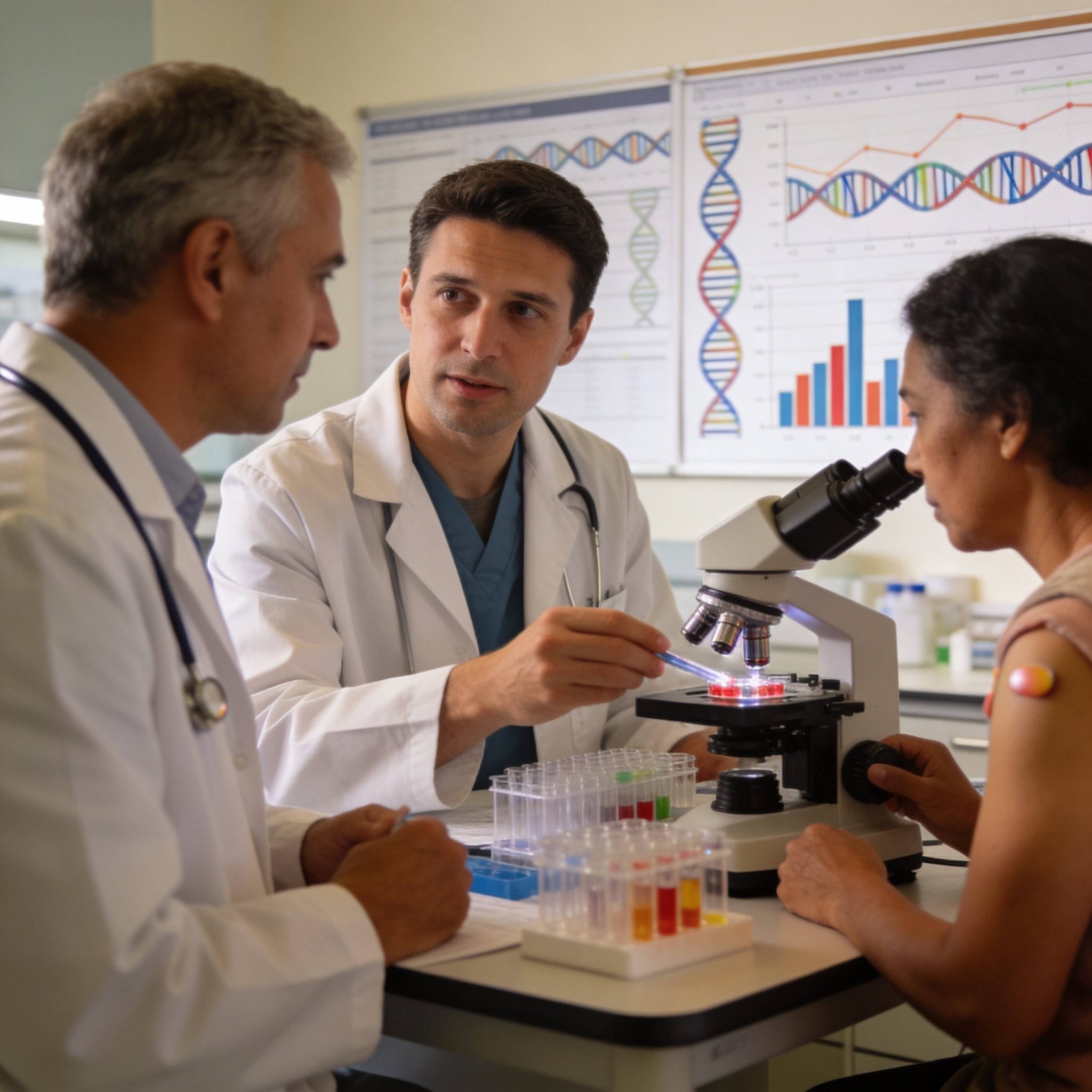
If the genome is the data, artificial intelligence is the decoder ring. The sheer volume of information contained in a single human genome — roughly three billion base pairs — has long outpaced the ability of any human physician to interpret it meaningfully. That bottleneck is dissolving, thanks to a new generation of AI tools designed specifically to work alongside genomic data.
In mid-2025, Stanford researchers unveiled CRISPR-GPT, an AI "copilot" built to assist scientists and clinicians in designing gene-editing strategies tailored to individual patients 1. The tool represents a dramatic acceleration in the translation of genomic research into clinical action, collapsing a process that once took months of expert consultation into a matter of hours. It is, in many ways, a symbol of the broader convergence reshaping medicine: the genome as raw material, AI as the craftsman.
Harvard Medical School has pushed this frontier even further. Researchers there developed a new AI tool capable of accurately identifying multiple drivers of disease within individual cells and predicting specific drug combinations that could restore those cells to healthy function 3. The tool does not merely flag a problem — it proposes a solution, drawing on vast genomic datasets to recommend therapies with a precision that human analysis alone could never achieve 3. That is a profound shift in how medicine is practiced.
The broader trend is confirmed by health innovation analysts at NCH Stats, who report that emerging health innovations in 2026 are increasingly centered on personalized medicine and precision care, with AI-genomics integration at the forefront of efforts to produce safer and more effective treatment outcomes 5. Meanwhile, researchers at CrownBio's genomics blog note that the future of genomic data analysis is being shaped by advances in single-cell sequencing, multi-omics integration, and machine learning — tools that allow scientists to examine not just what genes a patient carries, but how those genes are being expressed in real time 10.
This is medicine that learns. Every patient who undergoes genomic profiling adds to a growing reservoir of data, training algorithms to recognize patterns that would be invisible to even the most experienced clinician. The physician of 2026 is not replacing their judgment with a machine — they are amplifying it with one.
---
""Your genome is the most personal dataset imaginable — it reveals not only your own health risks but those of your parents, siblings, and children.""
From Cancer Wards to Cholesterol Clinics — Genomics in Action
The most dramatic early applications of genomic medicine have played out in oncology, where the stakes are highest and the evidence most compelling. Dana-Farber Cancer Institute made headlines in 2025 with the development of a new diagnostic tool that revolutionizes the diagnosis of acute leukemia — using genomic profiling to classify subtypes of the disease with a speed and accuracy that traditional pathology simply cannot match 14. For patients, faster and more precise diagnosis means faster, better-targeted treatment. It means less time in diagnostic limbo and more time receiving therapies designed specifically for their cancer's molecular signature.
But genomics is not confined to the cancer ward. In a development that has captured widespread attention, new clinical research is testing whether CRISPR gene editing can permanently lower cholesterol in patients at high cardiovascular risk — by switching off specific genes responsible for elevated LDL levels 16. The Associated Press reported in 2026 that these trials represent a genuine inflection point: the possibility that a single genomic intervention could replace a lifetime of daily medication for millions of patients 16. Researchers are cautious, noting that the science is still maturing, but the trajectory is unmistakable.
Genomics is also reshaping how clinicians think about aging itself. Large longitudinal studies have confirmed that faster "epigenetic aging" — a measure of how quickly a person's genome is accumulating biological wear — predicts significantly higher risk of mortality, heart disease, and other chronic conditions 9. According to longevity researchers tracked by Stacker, physicians in 2026 are increasingly incorporating epigenetic age testing into routine care, using it as an early warning system long before conventional biomarkers would raise an alarm 4.
Even the field of rare diseases, long neglected by a pharmaceutical industry focused on mass markets, is being transformed. Genomic sequencing is enabling diagnoses for patients who have spent years — sometimes decades — cycling through specialists without answers 17. For these individuals, a genomic diagnosis is not merely clinical data. It is, in the most literal sense, life-changing.
---

""The era of treating patients as statistics is over. Your DNA is the most powerful diagnostic instrument your doctor has ever held — and medicine will never be the same.""
The Road Ahead — Promise, Privacy, and the Patient of Tomorrow
The momentum behind genomic medicine is real, measurable, and accelerating. But it arrives with legitimate questions that medicine, law, and society have not yet fully resolved. Chief among them is privacy. Your genome is the most personal dataset imaginable — it reveals not only your own health risks but those of your parents, siblings, and children. As DNA testing becomes more routine, the question of who owns that data, who can access it, and how it might be used against patients in insurance or employment decisions is not hypothetical. It is urgent 21.
Consumer DNA testing platforms have already brought genomic data into millions of households, with services reviewed by outlets including Innerbody and CNET offering health-oriented DNA reports that flag predispositions to conditions ranging from Alzheimer's disease to certain cancers 78. The convenience is real. So is the complexity. Patients receiving raw genomic data without clinical context risk misinterpreting results, self-diagnosing incorrectly, or making medical decisions without proper guidance 26.
Regulatory frameworks are still catching up. The Innovative Genomics Institute notes that CRISPR clinical trials expanded significantly through 2025, but the ethical landscape surrounding gene editing — particularly the prospect of editing human embryos — remains deeply contested 1822. NPR reported in 2025 that scientists and ethicists are engaged in urgent debate over where the boundary between therapeutic intervention and so-called "designer baby" technology should be drawn 22. These are not abstract philosophical disputes. They are policy questions with real consequences for real families.
Yet the direction of travel is clear. Precision medicine, powered by genomics and amplified by artificial intelligence, is becoming the organizing principle of modern healthcare 20. The physician of the near future will not ask simply, "What disease do you have?" They will ask, "What does your genome tell us about who you are, what risks you carry, and how we can intervene before harm arrives?" That is a fundamentally different — and fundamentally better — question. And for the first time in history, we have the tools to answer it.
The era of treating patients as statistics is over. Your DNA is the most powerful diagnostic instrument your doctor has ever held — and medicine will never be the same.
---